

Guide to U.S. State Quarters
The 50 State Quarters Program has run its course with the release of five different quarters each year from 1999 to 2008. Each quarter featured a different design highlighting the uniqueness and history of each state.
The program has been credited with reinvigorating the hobby of coin collecting. It provided individuals with the opportunity to build an impressive collection of coins from their daily pocket change. The program also provided a valuable learning experience about the richness and diversity of the states. Anyone following or collecting the series could have learned a great deal about history and geography.
50 State Quarters Program
State Quarters were authorized under the 50 States Commemorative Coin Program Act (Public Law 105-124) signed into law on December 1, 1997 by President Clinton. The Act provided for the redesign and issuance of a circulating commemorative quarter dollar coin for each of the 50 States beginning in 1999.
At the time, the program represented an ambitious and unprecedented change for circulating coinage. New designs would be issued five times per year for a ten year period, yielding a total of fifty different designs. Before the program, a single design had been used for each denomination for a period of twenty five years of more. The design for the quarter dollar had remained essentially the same since the launch of the Washington Quarter series in 1932, with the exception of the bicentennial design used in 1976.
The authorizing legislation for the State Quarters explained some of the purposes of the new designs:
“To honor the unique Federal Republic of 50 States that comprise the United States; to promote the diffusion of knowledge among the youth of the United States about the individual states, their history and geography, and the rich diversity of the national heritage;” and to encourage “young people and their families to collect memorable tokens of all of the States for the face value of the coins.”
State Quarter Designs
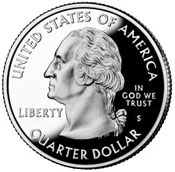
The obverse of each State Quarter bears a consistent design featuring a portrait of George Washington. The design is similar to the prior design of the Washington Quarter series. It bears four inscriptions, some of which previously appeared on the reverse of the quarter. The obverse inscriptions are: “United States of America,” “Liberty,” “In God We Trust,” and “Quarter Dollar.”
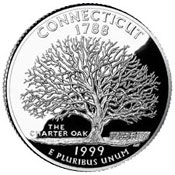
The reverse of each State Quarter carries a design emblematic of one of the 50 States. The authorizing legislation provided some basic guidelines for the design. Each quarter must bear a dignified design of which the citizens of the United States can be proud. No frivolous or inappropriate designs should be selected. In addition, the reverse design cannot use a head and shoulders portrait or bust of any person living or dead. No living person may be included in a design. Inscriptions typically found on all State Quarter reverses include the state name, statehood date, date of mintage, and “E Pluribus Unum.”
The reverse designs for each quarter were created through consultation with the governor of each state. The governor typically involved the citizens of the State and/or an appointed committee to generate potential design concepts. The United States Mint would generate coin designs based on the concepts, which would be reviewed by the governor, the Commission of Fine Arts, and the Citizens Coinage Advisory Committee. Final approval for each design would be at the discretion of the Secretary of the Treasury.
State Quarter Releases and Mintages
State Quarters have been released during the ten year period beginning with 1999 and concluding in 2008. Five different reverse designs have been issued per year with the release dates occurring at roughly ten weeks intervals. The order of release was based on the order the states ratified the Constitution or were admitted to the Union.
The mintages for each of the 50 State Quarters have varied widely over the ten year program. The highest mintages occurred in the first few years of the program with eight designs having a mintage over 1 billion from late 1999 to early 2001. The middle and later years of the program experienced the lowest mintages with twelve years having a mintage less than 500 million concentrated in 2003, 2004, and 2008.
After the 50 State Quarters
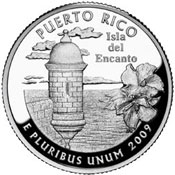
The 50 State Quarters Program reached completion in late 2008 with the release of the Hawaii Quarter. Under a separate provision included in the 2008 Consolidated Appropriations Act, quarters were issued in 2009 to honor the District of Columbia and the five United States Territories. The familiar obverse design from the State Quarters Program will be used with a unique reverse design for each of the six locations. This separate program was known as the District of Columbia and US Territories Quarters Program.
Starting in 2010, another program featuring rotating reverse designs for quarters was launched. The America the Beautiful Quarters were authorized under America’s Beautiful National Parks Quarter Dollar Coin Act of 2008. A total of 56 different quarters will be released over 12 years featuring a National Park or other National Site in each state, US territory, and the District of Columbia.